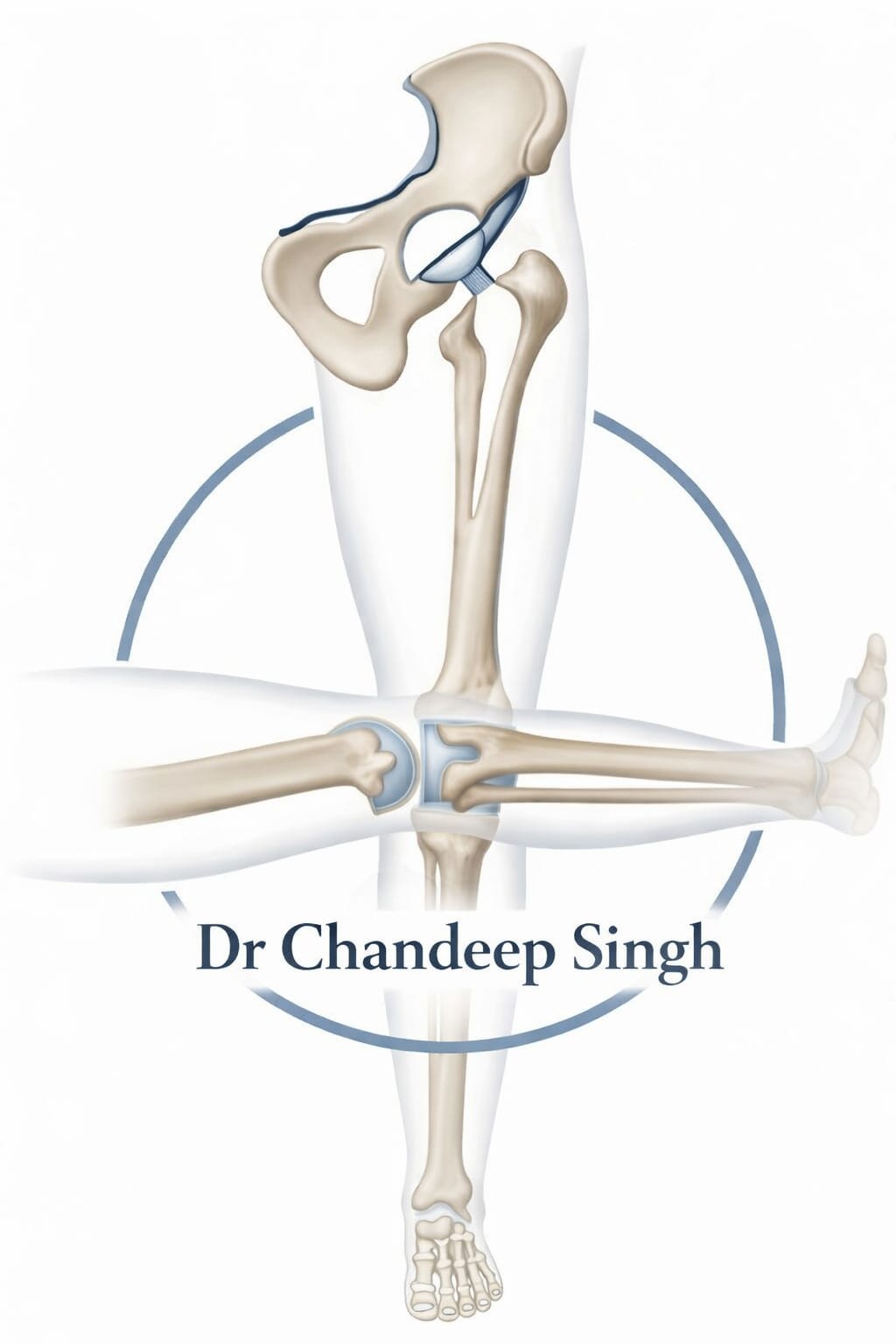
Total Hip Replacement is an advanced surgical procedure performed to treat severe hip arthritis, avascular necrosis, fractures, or joint damage that causes chronic pain and restricted movement. When non-surgical treatments fail, hip replacement helps restore joint function and mobility. At Orthopaedics, advanced Total Hip Replacement in Gurgaon is performed using modern implants and minimally invasive techniques aimed at relieving pain, improving walking ability, correcting deformity, and enabling patients to return to an active, independent lifestyle
Struggling with chronic hip pain, stiffness, or restricted joint movement? At YK Orthopaedics, Dr. Chandeep a renowned hip replacement surgeon in Gurgaon with over 14 years of experience — offers advanced, patient-focused care. He specializes in both joint-preserving treatments and complex hip replacement surgeries, delivering precise diagnosis and customized surgical solutions to restore mobility and quality of life.
Recognized as a trusted centre for hip replacement in Gurgaon, Orthopaedics provides modern procedures including total hip arthroplasty and advanced reconstruction techniques, supported by cutting-edge technology, personalized rehabilitation, and comprehensive recovery care.
Total Hip Replacement (Total Hip Arthroplasty) is a surgical procedure in which damaged or diseased parts of the hip joint are removed and replaced with artificial implants made of metal, ceramic, or high-grade plastic. It is commonly recommended for patients with severe arthritis, hip fractures, avascular necrosis, or advanced joint degeneration that limits daily activities. The surgery helps relieve chronic pain, restore joint function, improve mobility, and enhance overall quality of life.


The cost of hip replacement in Gurgaon is usually between ₹2,00,000 and ₹4,50,000, which is based on the type of procedure, implants, using implants, hospital facilities, and expertise of the surgeon. Advanced options such as hip replacement surgery in Gurgaon may cost slightly higher.
Note: Prices may vary depending on hospital, transplant type, and patient condition.
| Type of Procedure | Approximate Cost (INR) |
|---|---|
| Non-Surgical (Medication + Physiotherapy) | ₹15,000 – ₹30,000 |
| Core Decompression Surgery | ₹1,50,000 – ₹2,50,000 |
| Core Decompression with Bone Grafting | ₹1,50,000 – ₹2,50,000 |
| Core Decompression with Bone Marrow Aspirate | ₹2,50,000 – ₹3,00,000 |
| Bone Grafting | ₹2,00,000 – ₹3,00,000 |
| AVN Hip Replacement Surgery | ₹2,50,000 – ₹4,50,000 |
| Advanced AVN Therapy (PRP, etc.) | ₹30,000 – ₹75,000 |
| AVN Total Hip Replacement | ₹3,00,000 – ₹4,00,000 |
| AVN Ceramic Hip Replacement | ₹4,00,000 |
1. Total Hip Replacement
Replacing the ball-and-socket joint partially destroyed with artificial material, restoring mechanical movement and relieving pain.
2. Surgery to Resurface the Hips
An alternative to complete replacement that preserves more natural bone and is often suitable for younger, active patients.
3. Bilateral Replacement of the Hip
A procedure where both hip joints are replaced in one surgery due to severe pain or injury on both sides.
4. Hip Revision
A corrective surgery performed to repair or replace an already implanted hip joint that has worn out or failed.
5. Minimally Invasive Hip Replacement
A modern technique using smaller incisions, causing less tissue damage, faster recovery, and shorter hospitalization.



While complications are rare, possible risks include:
Before planning hip joint replacement in Gurgaon, the surgeon will:


Hip replacement surgery involves removing the damaged bone and cartilage from the hip joint and replacing the ball-and-socket joint with an artificial prosthetic implant made of durable materials. The implant is fixed using either cemented or cementless techniques for stability. After placement, the incision is closed, and rehabilitation begins soon after to restore movement. Advanced minimally invasive and computer-assisted techniques are often used to ensure greater precision, reduced downtime, faster recovery, and improved surgical outcomes.
An orthopaedic doctor specializes in diagnosing and treating conditions related to bones, joints, muscles, ligaments, and the spine.
You should consult an orthopaedic doctor if you experience joint pain, back pain, fractures, swelling, or difficulty in movement.
Knee pain is commonly caused by arthritis, ligament injuries, overuse, or age-related wear and tear.
Treatment depends on the cause and may include medication, physiotherapy, lifestyle changes, or in some cases, surgery.
Avoid moving the injured area and seek immediate medical attention for proper diagnosis and treatment.
Arthritis is a condition that causes inflammation in the joints, leading to pain, stiffness, and reduced mobility.
No, most orthopaedic conditions can be treated with non-surgical methods like medication and physiotherapy.